
Is an Unincorporated Association a Legal Entity? It Depends on the Question
By Kirk Carmichael · · 8 min read

Short answer: Increasingly, yes, but it depends on the state and the purpose. Under traditional common law, an unincorporated association was not a legal entity separate from its members. Modern statutes changed that in many states: Texas treats a nonprofit association as a legal entity separate from its members for contract and tort, the revised uniform act makes it "a legal entity distinct from its members and managers," and California lets associations own property and sue in their own names. Federal tax law and bankruptcy law also treat associations as entities for their own purposes.
"Is it a legal entity?" sounds like a yes-or-no question. For unincorporated associations, the honest answer is: for which purpose, and under which state's law? This guide walks through each area where the question matters, so you know what your association can do in its own name.
Key takeaways: Traditional common law: no separate entity. Modern statutes: yes, for contracts, torts, property and lawsuits in many states. Federal courts look to state law for capacity to sue. The IRS treats associations as entities for tax classification, and the Bankruptcy Code counts unincorporated associations as "corporations." Your state's statute is the starting point.
The traditional rule
At common law, an unincorporated association was simply its members acting together. It had no legal existence of its own. That meant it could not hold property in its own name, often could not sue or be sued as a group, and members who authorized a decision could be personally liable for it. Many older cases and some states still reflect that view.
How modern state statutes changed it
Uniform-act states
The revised Uniform Unincorporated Nonprofit Association Act says plainly that an association "is a legal entity distinct from its members and managers," with perpetual duration and the powers of an individual to carry on its purposes. Iowa's enactment is a good example (Iowa Code § 501B.5). Our guide to the Uniform Unincorporated Nonprofit Association Act explains the act in detail.
Texas
Texas, which adopted the original uniform act, makes a nonprofit association "a legal entity separate from its members for the purposes of determining and enforcing rights, duties, and liabilities in contract and tort" (Bus. Orgs. Code § 252.006). It can also own property in its name (§ 252.004) and sue and defend in its name (§ 252.007).
California
California's Corporations Code gives associations entity-like powers without using the uniform act: an association "may, in its name, acquire, hold, manage, encumber, or transfer an interest in real or personal property" (§ 18105), and under Code of Civil Procedure § 369.5 it "may sue and be sued in the name it has assumed or by which it is known." Nonprofit association members are protected from its debts by § 18605.
States without a modern statute
Elsewhere, the older rules may still apply in whole or in part. Associations there should be especially careful about how property is held and who signs contracts.
Area by area
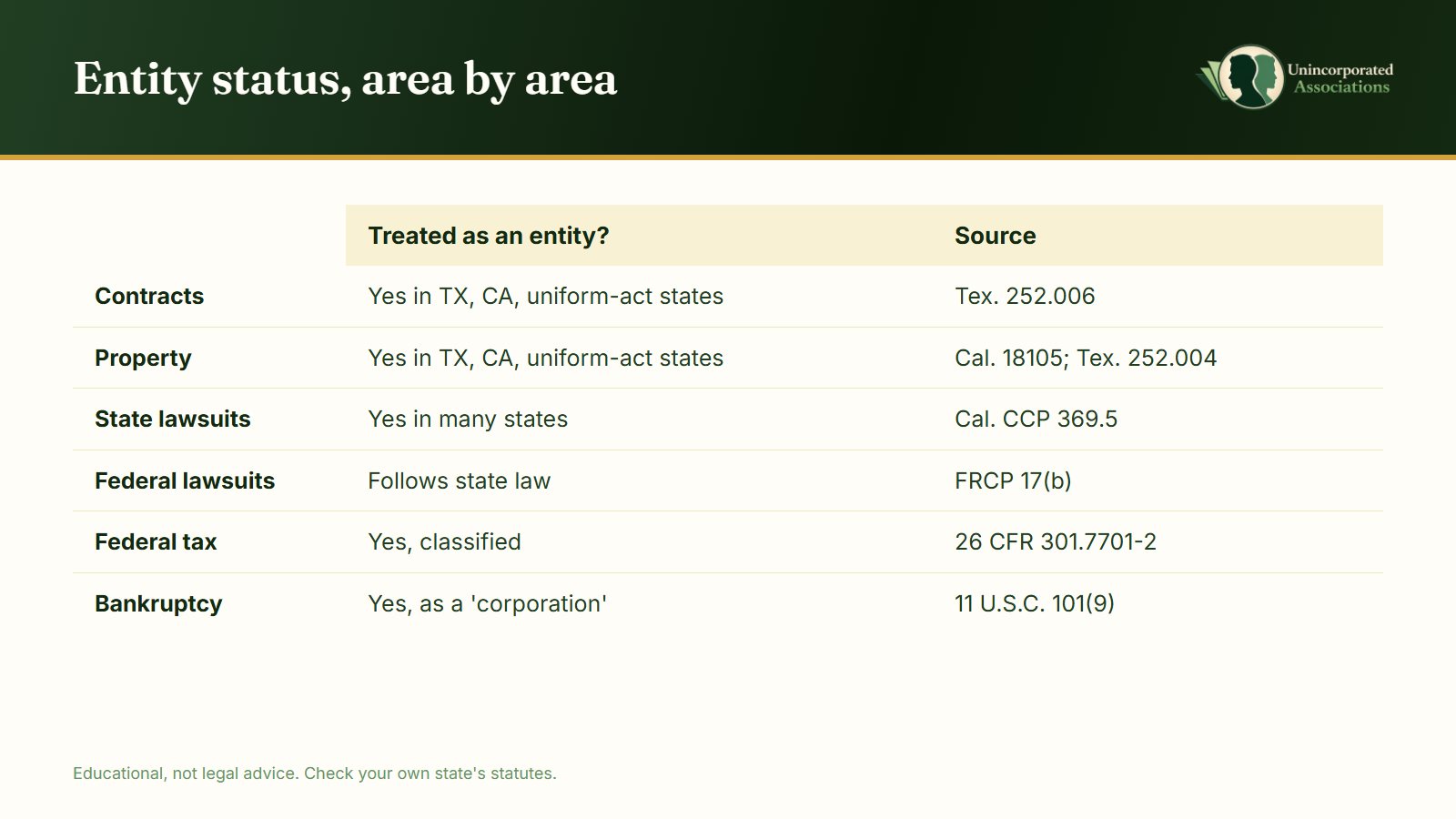
| Area | How associations are treated | Key source |
|---|---|---|
| Contracts | Can contract in their own name in TX, CA and uniform-act states | Tex. § 252.006; Cal. CCP § 369.5 |
| Property | Can own property in their own name in TX, CA and uniform-act states | Tex. § 252.004; Cal. § 18105 |
| Lawsuits in state court | Can sue and be sued in their own name in many states | Cal. CCP § 369.5; Tex. § 252.007 |
| Lawsuits in federal court | Capacity generally follows state law | FRCP 17(b) |
| Federal court citizenship | Citizen of every state where members are citizens | Bouligny; Carden |
| Member liability | Members not liable just for membership (nonprofit associations, in many states) | Cal. § 18605; Tex. § 252.006 |
| Federal tax | Classified as an entity (partnership, corporation or exempt) | 26 CFR 301.7701-2 |
| Bankruptcy | Counted as a "corporation" | 11 U.S.C. § 101(9) |
Federal courts
Under Federal Rule of Civil Procedure 17(b), an unincorporated association's capacity to sue or be sued in federal court is generally determined by the law of the state where the court sits, with an exception allowing suit in its common name to enforce federal rights.
For diversity jurisdiction, the Supreme Court has held that an unincorporated association takes the citizenship of each of its members: United Steelworkers v. R. H. Bouligny (1965) and Carden v. Arkoma Associates (1990). An association with members in many states is therefore a citizen of all of them, which can limit access to federal court.
Federal tax
For tax purposes, the IRS treats an association as an entity to be classified: a business entity (partnership by default, or corporation by election) or an exempt organization (26 CFR 301.7701-2). It gets its own EIN and, depending on classification, its own returns. See how unincorporated associations are taxed.
Bankruptcy
The Bankruptcy Code's definition of "corporation" expressly includes an "unincorporated company or association" (11 U.S.C. § 101(9)). In bankruptcy, an association is therefore treated as an entity distinct from its members.
Watch out: Entity status protects members only to the extent the statute says so, and only for genuine associations. Clear articles, a stated nonprofit purpose and good records are what show a court the association is the real thing; book a free call if you want help getting them right.
Why entity status matters day to day
Entity status sounds academic until something practical depends on it:
- Buying a building. If the association can own property in its own name, the deed names the association, and members coming and going does not affect title. Without that power, property must be held by trustees, and every change of trustee becomes paperwork.
- Signing a lease. An entity can be the tenant. Without entity status, landlords often ask individuals to sign, which puts those people on the hook personally.
- Being sued. If the association can be sued in its own name, a claim targets the association's assets. Without it, plaintiffs may name individual members.
- Receiving gifts. Texas expressly allows a nonprofit association to be a beneficiary of a trust, contract or will (§ 252.004), so a bequest to the association is effective.
- Continuity. The revised uniform act gives associations perpetual duration unless their rules say otherwise, so the association outlives any particular group of members.
Each of these is easier, cheaper and safer when your state treats the association as an entity and your documents are set up to use that status.
Questions to ask about your own association
- Which state's law governs it, and does that state have a modern association statute?
- Is it a nonprofit association under that statute, with a purpose and money rules that show it?
- Is property held in the association's name, or by individuals?
- Who signs contracts, and do they sign in the association's name?
- Has it filed any optional statement naming an agent?
Our guides on how to register an unincorporated association and unincorporated association documents help with the follow-up.
What this means in practice
If your association is in a state with a modern statute:
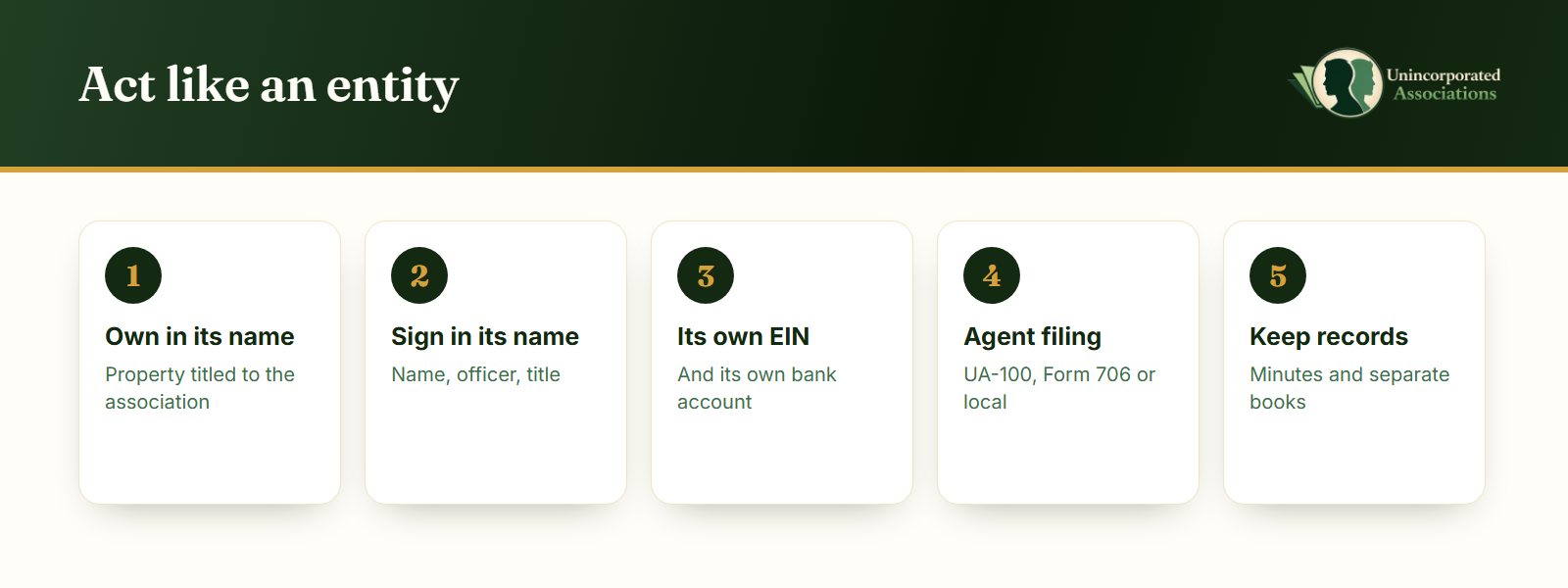
- Hold property in the association's name, not a member's.
- Sign contracts in the association's name, with the officer's title.
- Get an EIN and bank account in the association's name.
- Consider an optional agent filing so legal papers reach the right person (California UA-100; Texas Form 706).
- Keep records showing the association acts as an entity: minutes, separate books, signed documents.
If your state has no modern statute, take extra care: use trustees for property where needed, and get local advice on liability.
Pro tip: The more consistently your association acts like an entity, with its own name, EIN, account, contracts and records, the more easily banks, courts and agencies will treat it as one.
Is an unincorporated association a "person"?
Often, for specific purposes. Many statutes define "person" to include associations, which is how they can sue, contract and own property under those laws. But "person" is defined statute by statute; always check the definition in the particular law that applies.
Frequently asked questions
Is an unincorporated association a separate legal entity?
In many states, yes, for important purposes. Texas makes a nonprofit association a legal entity separate from its members for contract and tort, and the revised uniform act makes it "distinct from its members and managers." Under traditional common law, it was not.
Can an unincorporated association own property?
In states with modern statutes, such as California and Texas, yes, in its own name. In other states, property may need to be held by trustees for the association.
Can an unincorporated association be sued?
Yes. Many states let associations sue and be sued in their own names, and federal courts generally follow state law on capacity.
Is an unincorporated association a person under the law?
Many statutes define "person" to include associations, but the definition varies by law. Check the definition in the specific statute that applies.
Does entity status protect members from liability?
For nonprofit associations in states with protective statutes, members are not liable just for being members. Entity status does not protect people from their own conduct or guarantees, or protect co-owners of a for-profit business.
Sources
- Iowa Code chapter 501B (revised uniform act), including § 501B.5
- Texas Business Organizations Code §§ 252.004, 252.006, 252.007 and 152.051
- California Corporations Code §§ 18105 and 18605; Code of Civil Procedure § 369.5
- Federal Rule of Civil Procedure 17
- United Steelworkers v. R. H. Bouligny, Inc., 382 U.S. 145 (1965)
- Carden v. Arkoma Associates, 494 U.S. 185 (1990)
- 26 CFR 301.7701-2
- 11 U.S.C. § 101 (definitions, including "corporation")
Want your association set up to act as an entity from day one? Book a free 15-minute call with Kirk's team, or join the daily live Q&A.
Have questions? Bring them to the daily call.
Join our live Q&A every weekday and Saturday at 3PM PST, or get a free 15-minute call to see whether a UNA fits your situation.
Have a question about your situation?
Send us a message and we'll get back to you.
Keep reading
 The Well-Meaning Dragon: Straight Answers to the Hardest ObjectionsFor the family and friends who push back because they care — honest answers to the toughest questions about the Federal income tax and Unincorporated Associations.
 It's Not What You Believe, It's What You SignFor the cautious partner in the room: real risk rarely comes from asking questions. It comes from what you signed.
 What Most People Get Wrong About Taxes, Structure, and ControlThe real problem isn't taxes — it's structure, and who actually has control. A look at positioning over loopholes.
Educational, not legal or tax advice. Unincorporated Associations is a document-preparation and education company. Consult a licensed attorney or CPA before acting on any position discussed on this site.