
Avoid State Traps: LLP vs LLC and the S Corp Option (U.S.)
· 17 min read
Most small business owners in the US should form an LLC. It offers flexible taxation, simple ownership rules, and works for almost any industry. An LLP makes sense mainly for licensed professionals like lawyers, accountants, or architects who want protection from a partner’s malpractice. Before you file anything, check your state’s specific rules and talk to an attorney or tax advisor.
TL;DR:
- LLCs generally offer broader liability protection and flexible tax options, including S corp election, making them suitable for most small businesses.
- LLPs mainly protect partners from liability caused by other partners’ malpractice, which is crucial for licensed professional groups like lawyers or doctors.
- State restrictions often limit LLP formation to licensed professions, and additional costs like malpractice insurance may apply in certain states.
- LLCs allow simple ownership changes via operating agreement amendments, whereas LLP ownership transfers tend to be more complex and require renegotiation.
- A Private Unincorporated Association presents an alternative asset protection route outside LLCs and LLPs for individuals and freelancers seeking asset protection without public registration.
Table of Contents
- LLP vs LLC: The Core Differences at a Glance
- How Liability Protection Actually Plays Out
- Taxation: Where the Real Savings Show Up
- Formation Steps and State-by-State Traps
- Who Actually Runs the Business Day to Day
- What You’ll Actually Pay in Year One
- A Quick Checklist for Choosing Between Them
- A Third Option Worth Knowing About
- What Happens When You Add a Partner or Sell Your Stake
- How Your Profession Changes the Calculation
- Common Mistakes and My Final Take
- A Different Path: Forming a Private Unincorporated Association
- Where to Verify These Rules Yourself
- Sources
- FAQ
LLP vs LLC: The Core Differences at a Glance
An LLC, or limited liability company, is a business structure that separates your personal assets from your business debts while letting you choose how the IRS taxes your profits. An LLP, or limited liability partnership, is a partnership structure built specifically to protect each partner from liability caused by another partner’s negligence or mistakes, most often used by licensed professional groups.
The two structures sound similar because they share the letters “LP” and the liability-shield concept. But how each protects you, taxes you, and lets you bring in new owners diverges fast once you look past the acronym.
Here’s the head-to-head breakdown across the factors that actually change your decision:
- Liability protection: LLCs shield members from most business debts and lawsuits tied to the company. LLPs specifically protect partners from being personally liable for another partner’s malpractice or negligence, though the scope varies significantly by state.
- Taxation options: Both are pass-through entities by default for federal income tax, but LLCs can elect to be taxed as a sole proprietorship, partnership, C corporation, or S corporation. LLPs are generally locked into partnership taxation.
- Ownership structure: LLCs use “members” and allow flexible ownership, including single-member setups, corporate owners, and even foreign investors in most states. LLPs require at least two partners and are almost always limited to individuals actively practicing in the business.
- State eligibility: Every state allows LLC formation for nearly any lawful business. LLP formation is often restricted to licensed professions, and some states won’t recognize LLPs at all for certain fields.
- Costs and filings: Both require state filing fees and annual reports, but LLPs in some states carry added requirements like proof of malpractice insurance.
That last point deserves emphasis: state law determines whether an LLP is even available to you, and it dictates exactly what protection you get if it is. SCORE’s comparison of the two structures notes that both offer personal asset protection, but the extent and mechanics of that protection differ enough that treating them as interchangeable is a mistake. A software consultant in Texas and a law firm partner in New York are not choosing between the same two options, even though both might type “LLP vs LLC” into a search bar.
If you’re leaning toward flexibility and simplicity, the LLC usually wins. If you’re forming a professional partnership where malpractice exposure is a real concern, the LLP starts to make more sense. The next few sections dig into why.
How Liability Protection Actually Plays Out
The corporate veil is the legal wall between your personal bank account and your business’s debts. An LLC gives you that wall by default. If your business gets sued or can’t pay a vendor, creditors generally can’t come after your house, your car, or your personal savings, as long as you keep business and personal finances separate.
That wall has cracks, though. Courts can “pierce the corporate veil” if you commingle funds, skip basic formalities, or use the LLC to commit fraud. Personal guarantees on loans or leases also punch a hole straight through the shield. Sign a personal guarantee for a business line of credit, and the LLC protection means nothing on that debt.
LLPs work differently. Their signature feature is protecting individual partners from liability caused by other partners. If one architect in a three-person firm gets sued for a design error, the other two partners’ personal assets generally stay protected from that specific claim, even though the firm itself may still face liability. UpCounsel’s breakdown of LLC, LLP, and S corp structures frames this well: think of LLP protection as insulating you from malpractice and negligence, while LLC protection is broader and geared toward business debts and creditor claims generally.
Here’s where it gets practical. Say you’re one of four dentists in a group practice organized as an LLP. A patient sues over a botched procedure performed by your colleague. In most states, your personal assets stay out of that specific lawsuit, though the practice’s assets and insurance still take the hit. Now flip it: if your group formed an LLC instead and one member personally guaranteed the office lease, that member’s personal assets are exposed on the lease regardless of the LLC’s general protection.
Neither structure protects you from your own intentional wrongdoing or your own negligence. That part never changes.
Taxation: Where the Real Savings Show Up
Both structures start out as pass-through entities. That means the business itself doesn’t pay federal income tax. Profits and losses pass through to the owners’ personal tax returns, and each owner pays tax at their individual rate.
Where LLCs pull ahead is flexibility. An LLC can elect to be taxed as a sole proprietorship, a partnership, a C corporation, or an S corporation, depending on what saves the owners the most money. LLPs don’t get that menu. They’re generally taxed as partnerships, full stop.
The S corp election is the piece most new entrepreneurs miss, and it’s often the deciding factor for profitable single-owner or small-partner businesses. Here’s the mechanic: when an LLC elects S corp status, the owner who works in the business pays themselves a reasonable salary, which is subject to Social Security and Medicare taxes (FICA). Any remaining profit gets distributed to the owner without FICA tax attached. That split can meaningfully reduce your self-employment tax bill once your profits climb past what a reasonable salary would cover.
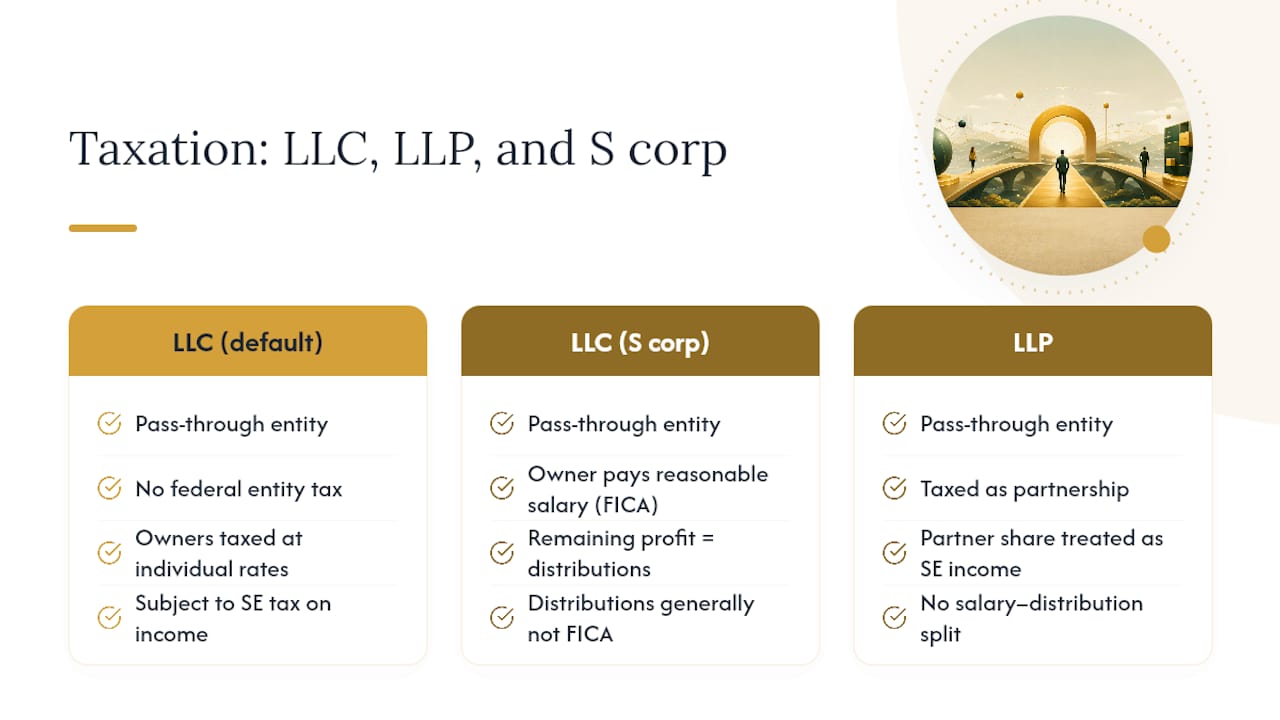
LLP partners generally don’t get this option. Their share of partnership income typically counts as self-employment income in full, meaning it’s subject to the complete self-employment tax rate with no salary-versus-distribution split available. UpCounsel’s comparison points to this as one of the sharpest financial differences between the two structures, particularly for high-earning professional partnerships.
A resource like this guide to business entity tax structures can help you model out what an S corp election would actually save you based on your numbers. But federal treatment is only half the picture. States layer on their own franchise taxes, gross receipts taxes, or annual LLC fees that vary widely, so run the full math with a tax advisor before assuming either structure wins on paper.
Formation Steps and State-by-State Traps
Forming either structure follows a similar skeleton, but the details diverge fast once you check your state’s rules.
- File your formation document. LLCs file Articles of Organization; LLPs file a Certificate of Limited Liability Partnership (naming conventions vary by state) with the Secretary of State.
- Appoint a registered agent. Both structures need someone with a physical address in the state to receive legal documents.
- Get an EIN from the IRS. You’ll need this for taxes, banking, and hiring, regardless of which structure you pick.
- Draft your governing document. LLCs use an operating agreement; LLPs use a partnership agreement, which we’ll cover in more detail below.
- File annual reports and pay ongoing fees. Both entities typically owe yearly filings to stay in good standing, and skipping them can jeopardize your liability protection.
The eligibility trap catches a lot of entrepreneurs off guard. State rules for LLP formation vary widely, and many states restrict LLPs to licensed professions like law, accounting, medicine, or architecture. Try to form an LLP for a marketing agency or an e-commerce store in one of those states, and you’ll get rejected outright. Some states also require proof of professional licensure or malpractice insurance before approving the filing.
Filing fees run anywhere from roughly $50 to a few hundred dollars depending on the state, with LLPs sometimes carrying higher fees or added insurance documentation requirements in certain jurisdictions. Timelines range from same-day online approval to several weeks for mail-in filings. Don’t guess on any of this. Confirm current fees, timelines, and eligibility rules directly with your state’s Secretary of State office before you file.
Who Actually Runs the Business Day to Day
LLCs give you two management options. A member-managed LLC means the owners run daily operations themselves, which fits small, hands-on businesses. A manager-managed LLC lets owners appoint someone, member or outsider, to handle operations while other members stay passive. That flexibility is a real advantage if you have investors who want equity without day-to-day involvement.
LLPs don’t offer that same split. Partners are generally expected to actively participate in the professional practice, which is part of why LLPs suit law firms and medical groups better than passive investment structures.
Operating agreements give LLCs far more customization room than LLP partnership agreements, which are often constrained by partnership law and the assumption that every partner works in the business. Whichever structure you choose, your governing document should spell out profit splits, voting thresholds, buyout terms, and how disputes get resolved. A vague or missing agreement doesn’t just create confusion. It can weaken the liability protection courts expect you to demonstrate you’ve maintained.
What You’ll Actually Pay in Year One
State filing fees for both structures typically run from around $50 to several hundred dollars, plus annual report fees that vary by state. LLCs generally stop there on the state-mandated side.
LLPs often carry extra costs. Several states require partners to maintain professional liability insurance or escrow arrangements as a condition of maintaining LLP status, particularly for medical, legal, and accounting practices. A resource like this guide to professional liability insurance walks through what that coverage typically costs and covers.
Budget for a registered agent service, attorney review of your formation documents, and your first year of tax preparation on top of state fees. Most entrepreneurs underestimate these secondary costs more than the filing fee itself.
A Quick Checklist for Choosing Between Them
Run through these questions before you file anything:
- Are you the only owner, or do you have a co-founder? Solo founders almost always want an LLC.
- Is your business a licensed profession like law, accounting, medicine, or architecture? If yes, check whether your state even permits an LLP for your field.
- Do you plan to raise money from outside investors? LLCs handle equity structures and passive investors far more easily than LLPs.
- Do you want the option to reduce self-employment tax through an S corp election? Only the LLC gives you that path.
A solo e-commerce founder or freelance consultant almost always wants an LLC. A four-partner accounting firm almost always wants an LLP. An investor-backed startup planning multiple funding rounds needs an LLC, since LLPs aren’t built for that kind of equity flexibility. A group of passive real estate investors usually leans LLC as well, given the broader liability shield and simpler ownership transfer.
Pro Tip: Bring your accountant a projected profit number, not just a business plan, before you meet with your attorney. The S corp election only pays off once your profit clears a certain threshold, and your accountant can tell you exactly where that line sits for your situation.
A Third Option Worth Knowing About
Before you file, it’s worth knowing that LLCs and LLPs aren’t the only asset protection frameworks available. A Private Unincorporated Association, or UNA, is a member-governed structure that some individuals use to hold and protect assets outside the traditional LLC or corporate filing system, without the public registry exposure or annual state fees those entities carry.
Attorney-backed documentation and lifetime support are available for people exploring this route, including a full walkthrough of how the formation process works. It’s not a fit for every business, particularly those needing outside investors or industry licensing. Talk to a qualified attorney and tax advisor before treating it as a replacement for an LLC or LLP.
What Happens When You Add a Partner or Sell Your Stake
Ownership transfer looks completely different depending on which structure you picked, and this trips up more founders than almost any other factor on this list.
LLCs generally handle new members and ownership changes through the operating agreement, which can spell out buy-in amounts, vesting schedules, and buyout formulas however the members want. Adding a new member to an LLC is often as simple as amending the operating agreement and updating your state filing, assuming your existing agreement lays out the process clearly. Some states require unanimous member consent unless the agreement says otherwise, so a vague agreement can stall a straightforward transaction for weeks.
LLPs are stickier. Because partnership law generally expects each partner to actively participate in the business, admitting a new partner usually means renegotiating the partnership agreement in more depth, covering not just capital contribution but also professional licensing, malpractice coverage, and voting rights. Exiting an LLP partner triggers similar complexity, especially in professional practices where the departing partner’s clients or cases need to transition smoothly.
Neither structure handles ownership transfer as cleanly as a corporation with tradable shares. But LLCs generally offer more contractual freedom to design a transfer process that fits your business, while LLPs stay bound more tightly to partnership norms and state partnership statutes. If you expect to bring in new owners within the next few years, build that expectation into your operating or partnership agreement from day one rather than trying to retrofit it later.

How Your Profession Changes the Calculation
The right structure shifts depending on what kind of professional service you run, and this is where a lot of generic advice falls apart.
Law firms and accounting practices are the classic LLP use case. LLPs are commonly used by professional firms specifically to protect partners from the malpractice of other partners while still letting them share management duties and profits. If you’re a partner in a firm where a colleague’s error could otherwise expose your personal assets, that protection is the entire reason to choose an LLP over an LLC.
Medical practices face a mixed picture. Many states allow LLPs for physician groups, but malpractice insurance requirements are often stricter and more expensive than for law or accounting LLPs, given the higher claim severity in medicine.
Architecture and engineering firms often have access to LLPs too, but eligibility varies enough by state that a firm operating across multiple states may need different structures in different locations, or a different entity altogether.
Creative and consulting fields, by contrast, rarely benefit from an LLP at all. Marketing agencies, design studios, and business consultants generally aren’t eligible for LLP status in most states because they aren’t licensed professions, and even where they are eligible, the malpractice protection LLPs offer doesn’t address the risks those businesses actually face, like breach of contract or general negligence claims. An LLC covers those risks more directly.
Common Mistakes and My Final Take
The biggest mistake I see is entrepreneurs choosing a structure based on what their business partner used, not what their own profession, tax situation, and growth plans actually require. Licensing rules and self-employment tax exposure change the math entirely from state to state and field to field.
My take: run the numbers with an accountant before you file, and confirm your state’s specific rules before you assume either structure applies to you.
— Kirk Carmichael
A Different Path: Forming a Private Unincorporated Association
If the LLC and LLP comparison has you thinking more broadly about asset protection, it’s worth knowing there’s a third route entirely outside the LLC and corporate filing system. Private Unincorporated Associations offer attorney-backed documentation, EIN assignment, and lifetime support, without the public registries and recurring state fees that come with LLCs and LLPs.

This isn’t a fit for every business, especially ones needing outside investors, professional licensing, or the LLC-style S corp tax election covered earlier. But if you’re an individual, freelancer, or family looking to protect assets and reduce unnecessary tax exposure outside a traditional entity, it’s worth a look. You can explore how the formation process works or book a free 15-minute call to see whether a UNA fits your situation before you file anything else.
Where to Verify These Rules Yourself
- SCORE’s LLC vs. LLP comparison covers liability protection and filing basics.
- GoDaddy’s LLP vs LLC resource explains federal tax treatment for both structures.
- SmartAsset’s LLC vs. LLP guide breaks down operating agreements and partnership agreements.
- UpCounsel’s LLC vs LLP vs S Corp comparison details the S corp election and self-employment tax math.
- FitSmallBusiness’s state-by-state LLP guide lists common state eligibility restrictions.
Sources
FAQ
Is an LLP better than an LLC?
Neither is universally better. LLPs typically suit licensed professional partnerships that want protection from a partner’s malpractice, while LLCs suit almost everyone else because of broader liability protection and tax flexibility, including the S corp election.
What is the downside of an LLP?
LLPs often carry state eligibility restrictions limited to licensed professions, may require malpractice insurance or escrow arrangements, and generally can’t access the S corp tax election that helps LLC owners reduce self-employment tax.
Does an LLP have a CEO?
No. LLPs are governed by partners under a partnership agreement, not a corporate hierarchy with a CEO; partners are generally expected to actively participate in running the practice.
Does LLP mean it’s a law firm?
No. LLP stands for limited liability partnership, and while law firms commonly use this structure, so do accounting firms, medical practices, and other licensed professional partnerships depending on state rules.
Recommended
- How a Private Unincorporated Association Can Reduce Taxes
- How to Become an Unincorporated Association
- What Is an Unincorporated Association?
This article is provided for general informational and educational purposes only and does not constitute legal, tax, accounting, or financial advice. Reading this content or contacting UnincorporatedAssociations.com does not create an attorney-client, CPA-client, or other professional-client relationship. In accordance with IRS Circular 230, any discussion of federal tax matters herein is not intended or written to be used, and cannot be used, for the purpose of avoiding penalties.
Have questions? Bring them to the daily call.
Join our live Q&A every weekday and Saturday at 3PM PST, or get a free 15-minute call to see whether a UNA fits your situation.
Have a question about your situation?
Send us a message and we'll get back to you.
Keep reading
 The Well-Meaning Dragon: Straight Answers to the Hardest ObjectionsFor the family and friends who push back because they care — honest answers to the toughest questions about the Federal income tax and Unincorporated Associations.
 It's Not What You Believe, It's What You SignFor the cautious partner in the room: real risk rarely comes from asking questions. It comes from what you signed.
 What Most People Get Wrong About Taxes, Structure, and ControlThe real problem isn't taxes — it's structure, and who actually has control. A look at positioning over loopholes.
Educational, not legal or tax advice. Unincorporated Associations is a document-preparation and education company. Consult a licensed attorney or CPA before acting on any position discussed on this site.