
The series that took Brad off the plantation.
Four-part taxation series on the Lil Talk Show, plus the bonus follow-up on what to do when the IRS letter actually shows up in your mailbox.
Brad shares his own testimony on the show — about $140,000 saved after applying the framework, and what it felt like "leaving the plantation".
- 5
- Episodes
- 4
- Series parts
- 17+
- Years tax-free

Five episodes. One framework.
The four-part taxation series builds in order — Part 1 lays the ground, the Summary closes the loop. The bonus IRS-letters episode came later and stands on its own.
- 1Part 1 of 4
How the income-tax system actually works
Where the federal income tax actually comes from — and who it actually reaches.
The opening lesson of the 4-Part Taxation Series. Kirk lays the historical and statutory ground every later episode builds on: who the income tax is for, what it isn't, and the cascade of forms that quietly establishes the relationship.
Watch - 2Part 2 of 4
Jurisdiction, contracts, and the Social Security number
Where authority comes from, and the role the SSN quietly plays.
Part two of the series. Kirk walks through how jurisdiction is established, how the Social Security number functions inside the federal tax system, and what that means for everything you sign without thinking about it.
Watch - 3Part 3 of 4
The Revocation of Election explained
The formal mechanism the system itself provides for stepping out.
Part three. Kirk introduces the Revocation of Election — the documented mechanism for changing your election with the federal income-tax system — and walks through the steps Brad's audience asked about most.
Watch - 4Series summary
4-Part Taxation Series — Summary
All four parts, condensed. Plus Joe Bannister's testimony.
The capstone of the series. Kirk synthesizes the framework into a step-by-step blueprint and weaves in former IRS investigator Joe Bannister's testimony on the legal basis for filing — closing the loop on the historical and statutory through-line.
Watch - Bonus episode
IRS letters and what they mean
Education replaces fear. Here's how to read the envelope.
A standalone follow-up. After the series aired, Brad's audience came back with the same question: I just got a letter from the IRS — now what? Kirk walks through how to read it, what the timelines mean, and how education replaces the gut-punch reaction.
Watch
Watch the whole series on this page.
Each episode plays inline via the Vimeo embed. Topics are listed under every video so you can scrub to the part you care about.
- Part 1 of 4
How the income-tax system actually works
Where the federal income tax actually comes from — and who it actually reaches.
The opening lesson of the 4-Part Taxation Series. Kirk lays the historical and statutory ground every later episode builds on: who the income tax is for, what it isn't, and the cascade of forms that quietly establishes the relationship.
Open on VimeoTopics discussed- The historical setup behind today's federal income tax.
- Who the tax was originally written for — and who it was not.
- How the modern system is presented vs. how it actually operates.
- Part 2 of 4
Jurisdiction, contracts, and the Social Security number
Where authority comes from, and the role the SSN quietly plays.
Part two of the series. Kirk walks through how jurisdiction is established, how the Social Security number functions inside the federal tax system, and what that means for everything you sign without thinking about it.
Open on VimeoTopics discussed- How jurisdiction is established — and how it's extended.
- The SSN's actual role inside federal reporting.
- Why agreements you've already signed shape what applies to you.
- Part 3 of 4
The Revocation of Election explained
The formal mechanism the system itself provides for stepping out.
Part three. Kirk introduces the Revocation of Election — the documented mechanism for changing your election with the federal income-tax system — and walks through the steps Brad's audience asked about most.
Open on VimeoTopics discussed- What the Revocation of Election actually is.
- Why most tax professionals never reference it.
- What changes downstream of filing one.
- Series summary
4-Part Taxation Series — Summary
All four parts, condensed. Plus Joe Bannister's testimony.
The capstone of the series. Kirk synthesizes the framework into a step-by-step blueprint and weaves in former IRS investigator Joe Bannister's testimony on the legal basis for filing — closing the loop on the historical and statutory through-line.
Open on VimeoTopics discussed- A step-by-step blueprint for the framework Kirk uses.
- The Social Security number's role inside the federal system.
- Joe Bannister's testimony as a former IRS investigator on the legal basis for filing.
- Historical origins: the 16th Amendment, the Federal Reserve Act of 1913.
- Bonus episode
IRS letters and what they mean
Education replaces fear. Here's how to read the envelope.
A standalone follow-up. After the series aired, Brad's audience came back with the same question: I just got a letter from the IRS — now what? Kirk walks through how to read it, what the timelines mean, and how education replaces the gut-punch reaction.
Open on VimeoTopics discussed- Revocation of Election as a framework for stepping out of the federal income-tax system.
- How unincorporated associations remove asset reporting tied to Social Security numbers.
- Kirk's exit from the traditional tax system in 2009 and what made it work.
- The psychological impact of IRS letters — and how education replaces fear.
The same framework, in writing.
Watching the series and then sitting with the documents is the path most members took. Three PDFs — the long-form guide, the workbook, and the member agreement template.
The Strategic Guide
The full walkthrough of the framework Brad's series introduces — written down, with the cross-references.
The FAQ Workbook
33 pages of the same questions Brad's audience kept asking after the series aired.
UA Member Agreement
The member agreement — the literal contract that anchors what Kirk talks about across all five episodes.
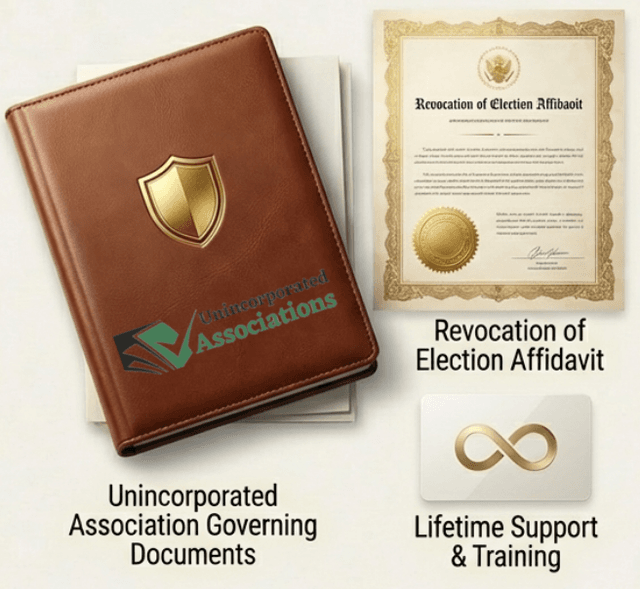
Governing documents + Revocation of Election affidavit
Once you've watched the series, the next step is the actual paper — the association's governing documents, the ROE affidavit, and ongoing member support. Same framework Brad applied to save $140,000.
Same framework. Live, Monday through Saturday.
The series gives you the structure. The 10AM Q&A is where Kirk walks through the specifics for your situation — bring the part of an episode that landed and we'll go from there.